

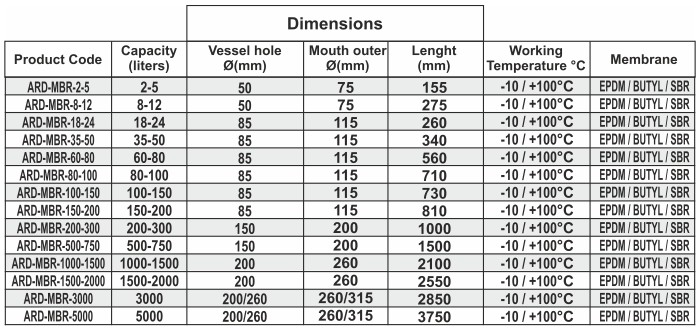
Openline are expansion tanks for centralized open circuits suited to absorb Hie increased water volume when Hie temperature in the heating system increases. It is assembling to roof attics.
Inoxline is a brand name of a series of stainless steel pipes and fittings that are used for various applications, such as water supply, heating, cooling, gas distribution, fire protection, and industrial processes.
Inoxline products are designed to be durable, corrosion-resistant, hygienic, and easy to install and maintain. Inoxline products are also compatible with different types of membranes, which are thin and flexible materials that act as selective barriers for separating or filtering different substances. Membranes are widely used in various fields, such as water treatment, gas separation, energy production, biotechnology, and medicine.
Membranes can be classified into different types, depending on their material, structure, and function. Some of the most common types of membranes are: Polymeric membranes: These are made from synthetic or natural polymers, such as polyethylene, polypropylene, polyvinylidene fluoride, polysulfone, cellulose acetate, and polyimide. Polymeric membranes are usually cheap, easy to fabricate, and versatile, but they may suffer from low thermal and chemical stability, fouling, and swelling.
Inorganic membranes: These are made from metal, ceramic, glass, or carbon materials, such as alumina, silica, zirconia, titania, zeolite, graphene, and carbon nanotubes. Inorganic membranes are usually more stable, resistant, and selective than polymeric membranes, but they may be more expensive, brittle, and difficult to manufacture.
Composite membranes: These are made from a combination of polymeric and inorganic materials, such as polymer-inorganic nanocomposites, polymer-inorganic hybrid membranes, and mixed matrix membranes. Composite membranes aim to combine the advantages of both polymeric and inorganic membranes, such as high performance, low cost, and good mechanical properties. One of the main challenges in membrane technology is to develop membranes that have high permeability and selectivity, as well as good mechanical, thermal, and chemical stability. Inoxline and membranes can work together to achieve these goals, as Inoxline products can provide a strong and reliable support for membranes, while membranes can enhance the functionality and efficiency of Inoxline products. For example, Inoxline pipes and fittings can be coated with membranes to improve their corrosion resistance, or Inoxline products can be used as housings or modules for membrane systems. Some of the potential applications of Inoxline and membranes are:
Water treatment: Inoxline and membranes can be used for desalination, purification, filtration, and disinfection of water, as well as for wastewater treatment and reuse. For instance, Inoxline products can be used as supports for reverse osmosis, nanofiltration, ultrafiltration, or microfiltration membranes, which can remove salt, contaminants, bacteria, and viruses from water. Inoxline products can also be used as components for membrane bioreactors, which can degrade organic pollutants and nutrients from wastewater using microorganisms.
Gas separation: Inoxline and membranes can be used for separating, enriching, or purifying different gases, such as hydrogen, oxygen, nitrogen, carbon dioxide, methane, and helium. For example, Inoxline products can be used as supports for gas separation membranes, such as palladium, zeolite, or carbon membranes, which can selectively permeate certain gases based on their size, solubility, or affinity. Inoxline products can also be used as components for membrane reactors, which can combine gas separation and chemical reaction in one unit.
Energy production: Inoxline and membranes can be used for generating, storing, or converting different forms of energy, such as electricity, heat, or fuel. For instance, Inoxline products can be used as supports for energy-related membranes, such as proton exchange membranes, solid oxide membranes, or ion exchange membranes, which can facilitate the transport of ions or electrons in electrochemical devices, such as fuel cells, batteries, or electrolyzers. Inoxline products can also be used as components for membrane distillation, which can produce fresh water and thermal energy from saline water using a temperature difference. In conclusion, Inoxline and membranes are two complementary technologies that can offer various benefits and opportunities for different applications. Inoxline products can provide a high-quality and durable support for membranes, while membranes can improve the performance and functionality of Inoxline products. Together, Inoxline and membranes can create innovative and efficient solutions for water treatment, gas separation, energy production, and more.